- Main
- News
- “GLOBAL ENVIRONMENTAL SYNDROMES” — A KEYNOTE LECTURE BY PROFESSOR CHRISTIAN OPP OF THE UNIVERSITY OF MARBURG (GERMANY)
“GLOBAL ENVIRONMENTAL SYNDROMES” — A KEYNOTE LECTURE BY PROFESSOR CHRISTIAN OPP OF THE UNIVERSITY OF MARBURG (GERMANY)
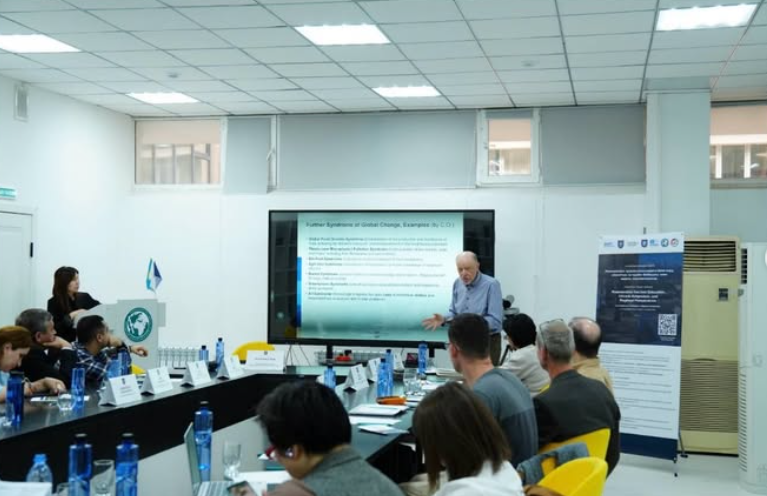
5 November 2026. As part of the international project seminar “Regenerative Tourism Education, Climate Adaptation, and Regional Perspectives,” Al-Farabi Kazakh National University hosted a series of lectures by Professor Christian Opp of the University of Marburg on the topic of “Global Environmental Syndromes.”
In the first part of his lecture, Professor Opp introduced the general concept of global environmental syndromes — persistent patterns of interaction between society and the environment shaped by human economic activities and natural processes. Various environmental phenomena and challenges were examined as examples, including the Green Revolution Syndrome, the Sahel Syndrome, the Contaminated Land Syndrome, the Mass Tourism Syndrome and the Dust Bowl Syndrome. Particular attention was paid to the environmental challenges facing Central Asia.
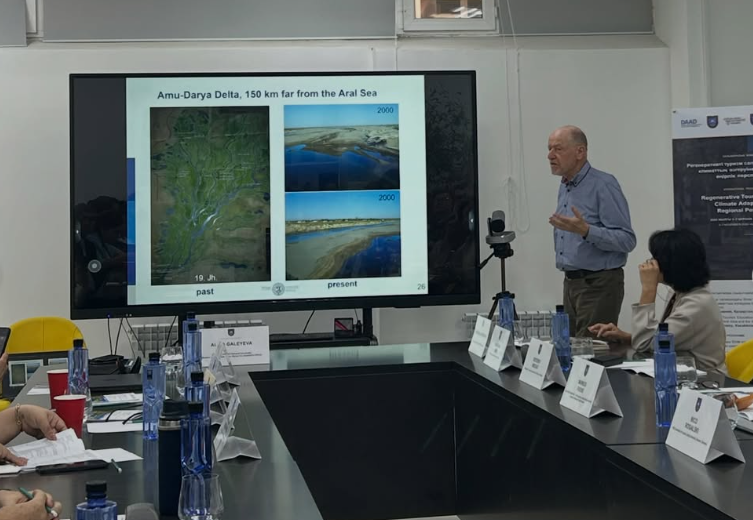
In the second part of his presentation, Professor Opp examined the Aral Sea Syndrome, while the third part focused on the Dust Bowl Syndrome in the regional context. These examples highlight the consequences of unsustainable natural resource management, land degradation, changes in water resources and the need for more responsible management of natural areas.
The lecture's subject matter is closely aligned with the United Nations Sustainable Development Goals (SDGs), particularly SDG 6 (Clean Water and Sanitation), SDG 13 (Climate Action) and SDG 15 (Life on Land).
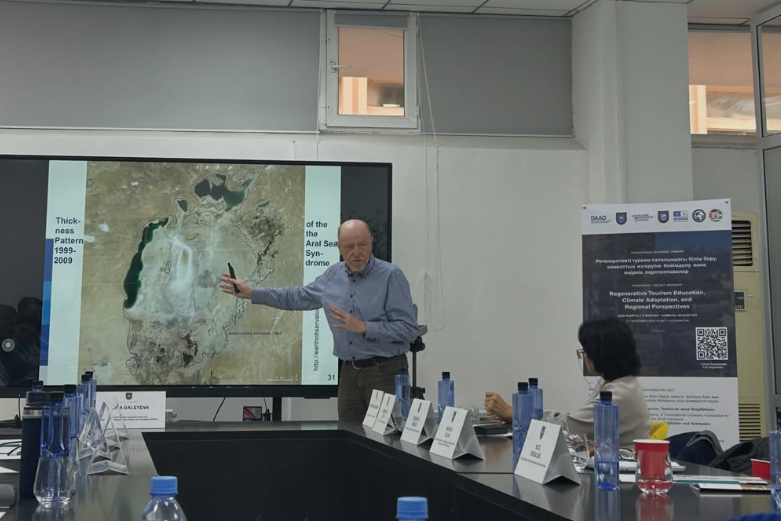
Examining such environmental challenges is essential for developing scientifically grounded approaches to climate change adaptation and regenerative tourism development. The lecture became an important part of the academic exchange within the seminar, bringing together researchers and members of the academic community to discuss environmental challenges and prospects for sustainable development in Central Asia.