KazNU research explores the structure of light nuclei and hypernuclei
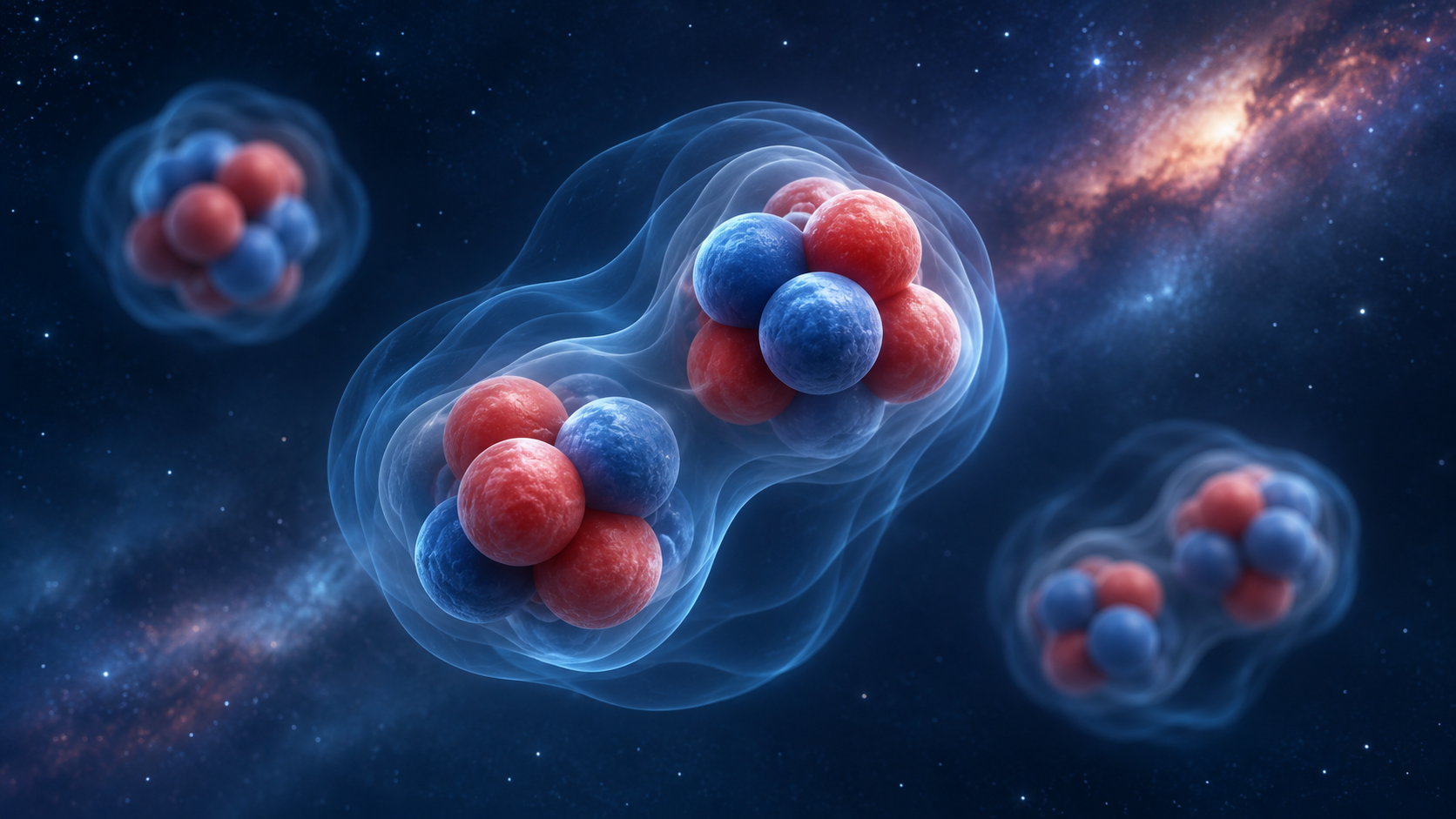
A research project at Al-Farabi Kazakh National University aims to improve the theoretical description of light atomic nuclei and hypernuclei. By refining cluster models, researchers plan to account more fully for the internal structure of interacting nuclei and the different channels through which nuclear reactions can proceed. The work connects nuclear structure theory with questions about the formation of light elements and the evolution of matter in the Universe.
The project, entitled “Structure of Light Nuclei and Hypernuclei in Multichannel and Multicluster Models”, is planned for 2024–2026. Its objective is to extend microscopic methods for studying nuclear structure and reaction dynamics. The programme focuses on bound and resonant states, including systems involving helium and lithium isotopes. The intended outcome is a more detailed theoretical approach that can also support the investigation of other nuclear systems.
A large body of experimental evidence describes atomic nuclei, yet no single theoretical model accounts for all their known characteristics. Describing the interactions between protons and neutrons remains a demanding problem. Highly excited states introduce further difficulties because a nucleus may have many possible decay channels. Developing methods that can treat these channels together is therefore an important part of the planned research.
Accounting for the structure within a nucleus
Cluster models describe groups of nucleons within a nucleus as substructures called clusters. These may include a deuteron, a triton, or a helium-3 or helium-4 nucleus within a more complex system. Interactions between the clusters contribute to the properties of the whole nucleus. This approach simplifies calculations while retaining information about nuclear structure. Its accuracy depends in part on how well the model represents the clusters themselves.
The proposed microscopic approach accounts for the internal structure of the clusters and the Pauli exclusion principle, which restricts the quantum states available to identical particles. The work uses a multichannel three-cluster framework. It describes a three-cluster system through two-body interactions in the entrance and exit channels of a reaction. This provides a way to analyse several possible decay pathways within the same theoretical framework.
For resonant states, the researchers plan to determine energies, total widths and partial widths. Partial widths describe the contributions of individual decay channels, while the total width is related to a resonance’s lifetime. As excitation energy increases, more channels become accessible and the analysis becomes more complex. The project therefore includes the development of algorithms to identify resonances and calculate their parameters across different two-cluster and three-cluster configurations.
The methodological basis builds on earlier investigations of lithium-6, which examined its ground state and resonant states. Those studies demonstrated the role of cluster polarisation, meaning changes in the internal structure of clusters as they interact. The new work aims to extend this treatment to further systems. Particular attention is planned for polarisation effects at low collision energies, where they may influence the characteristics of nuclear reactions.
Hypernuclei and the formation of lithium
One research task concerns the bound and resonant states of helium and lithium hypernuclei with mass number six. Hypernuclei contain a hyperon in addition to protons and neutrons. The calculations will represent these systems as three-cluster structures comprising a helium-4 nucleus, a neutron or proton, and a Λ hyperon. The researchers intend to determine resonance parameters and the probabilities of decay through the available two-cluster channels.
A further task examines the reaction , in which helium-6 interacts with a proton to produce lithium-6 and a neutron. Its analysis will account for different three-cluster configurations and the binary channels of lithium-7. Highly excited states of lithium-7 are also included in the research programme. Studying structure and reaction channels together is intended to provide a fuller description of the processes involving these light nuclei.
The astrophysical relevance lies in understanding how light elements formed during different stages of the Universe’s evolution. Reactions involving lithium are of interest in discussions of the cosmological lithium problem. More detailed calculations may provide additional nuclear data for that discussion. The project seeks to refine the theoretical description of the relevant reactions as a contribution to this broader scientific question.
The three-cluster microscopic model will also be applied to reactions between helium-3 and tritium. The exit channels to be considered include helium-4 and a deuteron, lithium-5 and a neutron, and helium-5 and a proton. The programme additionally covers radiative capture reactions that produce lithium-6: and . Here, d denotes a deuteron and γ the emitted photon.
Planned scientific outputs
For the selected reactions, the researchers plan to calculate astrophysical S-factors and reaction rates. These quantities are used to describe nuclear processes under astrophysical conditions. Accounting more fully for internal structure and cluster polarisation is expected to extend the scope of the theoretical analysis. The calculations may inform further nuclear structure studies and the planning of new experiments.
The project envisages presenting its findings at international conferences and publishing at least two papers in journals within the first three quartiles by impact factor in Web of Science, or journals with a Scopus CiteScore percentile of at least 50. Some material is also intended for lectures and research undertaken by master’s and doctoral students. The principal anticipated outcome of this fundamental research is an improved method for investigating light nuclei and hypernuclei that can be applied to further problems in nuclear physics.
Other news