- Main
- News
- KazNU scientists and students take part in the International Scientific and Educational School "Dubna"
KazNU scientists and students take part in the International Scientific and Educational School "Dubna"
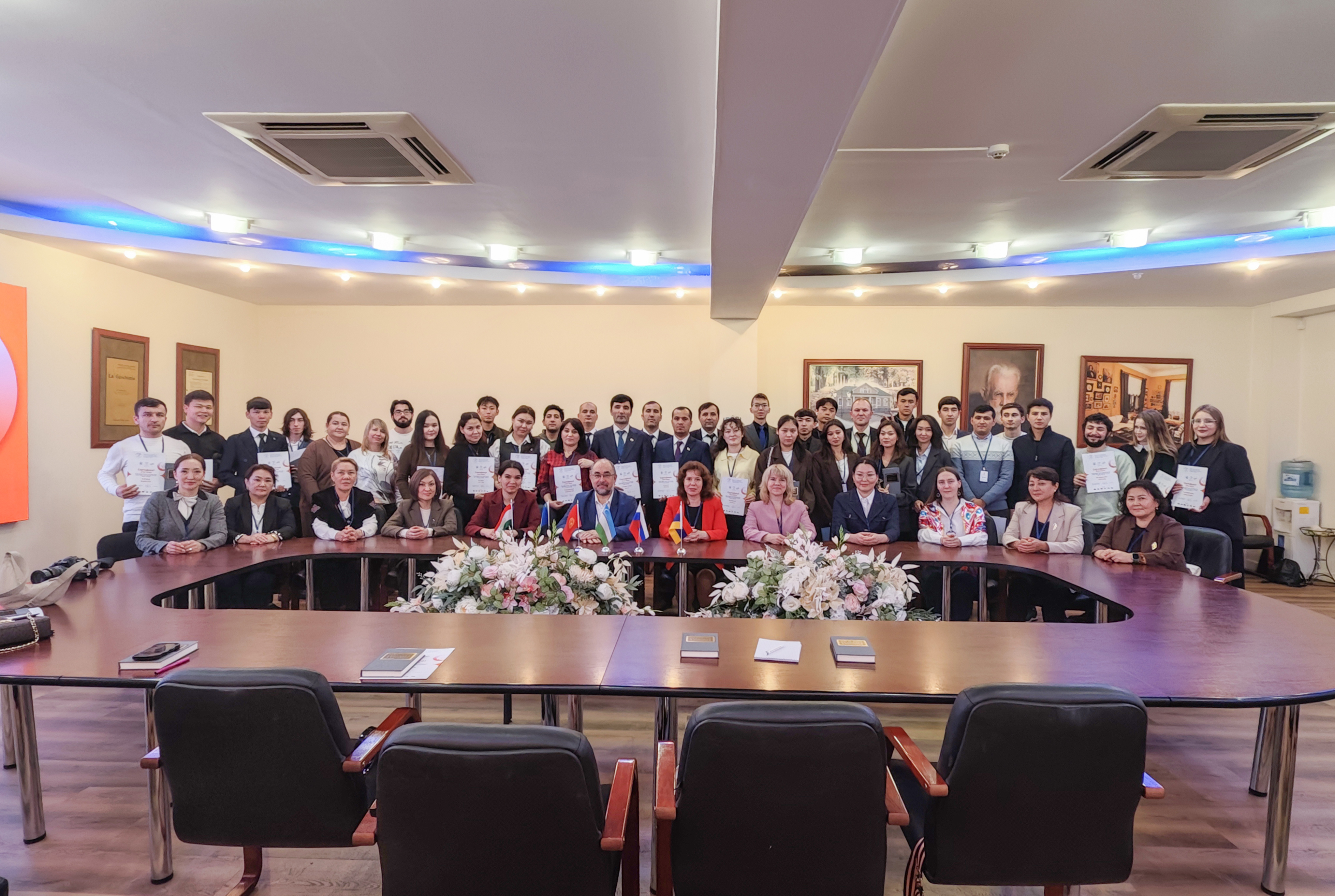
From November 15 to 21, 2026, the International Scientific and Educational School “Dubna” for students and young scientists from the Commonwealth of Independent States (CIS) was held in Dubna, Russia. The event was organized by Dubna State University with the support of the Intergovernmental Foundation for Educational, Scientific and Cultural Cooperation of the CIS (IFESCCO) and the Joint Institute for Nuclear Research (JINR). The school brought together students and young researchers from Armenia, Kazakhstan, Kyrgyzstan, Tajikistan, Uzbekistan, and Russia.
The official opening ceremony took place on November 16. The program covered a wide range of topics, from fundamental physics and artificial intelligence to technological entrepreneurship and international scientific cooperation. Participants attended lectures, took part in scientific discussions, visited the laboratories of Dubna State University, and explored the research facilities of the Joint Institute for Nuclear Research, including laboratories specializing in nuclear reactions and high-energy physics.
As part of Partnership Day, participants visited the National Research University “Moscow Power Engineering Institute” (NRU MPEI) in Moscow, where they discussed joint educational programs, digital transformation, and career opportunities in science and business. The final days of the school were held at Dubna State University as part of Technology and Entrepreneurship Day. The program included an interactive technology transfer activity and a roundtable discussion on humanitarian cooperation among CIS countries.
The main objectives of the school were to strengthen cooperation among young people from CIS member states, contribute to achieving the Sustainable Development Goals, and facilitate young scientists' access to research infrastructure across the Commonwealth. The program included scientific and educational activities, practical exercises aimed at overcoming language barriers, educational excursions, and international exchanges of knowledge and experience among participants.
Upon completion of the program, all participants received certificates signed by A. S. Denikin, Rector of Dubna State University.
Participation in the international school contributes to strengthening the scientific ties between Al-Farabi Kazakh National University (KazNU), the Joint Institute for Nuclear Research, and leading Russian universities. Furthermore, it opens up new opportunities for our students and young scientists to conduct joint research, participate in international scientific projects, and undertake research internships at foreign scientific institutions.
This event is closely aligned with the United Nations Sustainable Development Goals (SDGs):
SDG 4 - Quality Education. This is the primary goal, as the international school was a scientific and educational program designed for students and young scientists. The program included lectures, visits to research laboratories, and educational activities. Upon completion of the program, participants were awarded certificates.
SDG 17 - Partnerships for the Goals. The international school brought together representatives from six CIS countries and was jointly organized by three institutions: Dubna State University, the Intergovernmental Foundation for Educational, Scientific and Cultural Cooperation of the CIS (IFESCCO), and the Joint Institute for Nuclear Research (JINR). The program also included Partnership Day at the National Research University “Moscow Power Engineering Institute” (NRU MPEI) in Moscow and a roundtable discussion dedicated to strengthening international cooperation.
SDG 9 - Industry, Innovation and Infrastructure. Participants explored the modern research infrastructure of the Joint Institute for Nuclear Research (JINR), including the NICA project, and took part in educational activities focused on technological entrepreneurship, innovation, and technology transfer.
Other news