- Main
- AL-FARABI NEWS LETTERS
- KazNU Scientists Study the Development of New Biomaterials Based on Microbial Exopolysaccharides
KazNU Scientists Study the Development of New Biomaterials Based on Microbial Exopolysaccharides
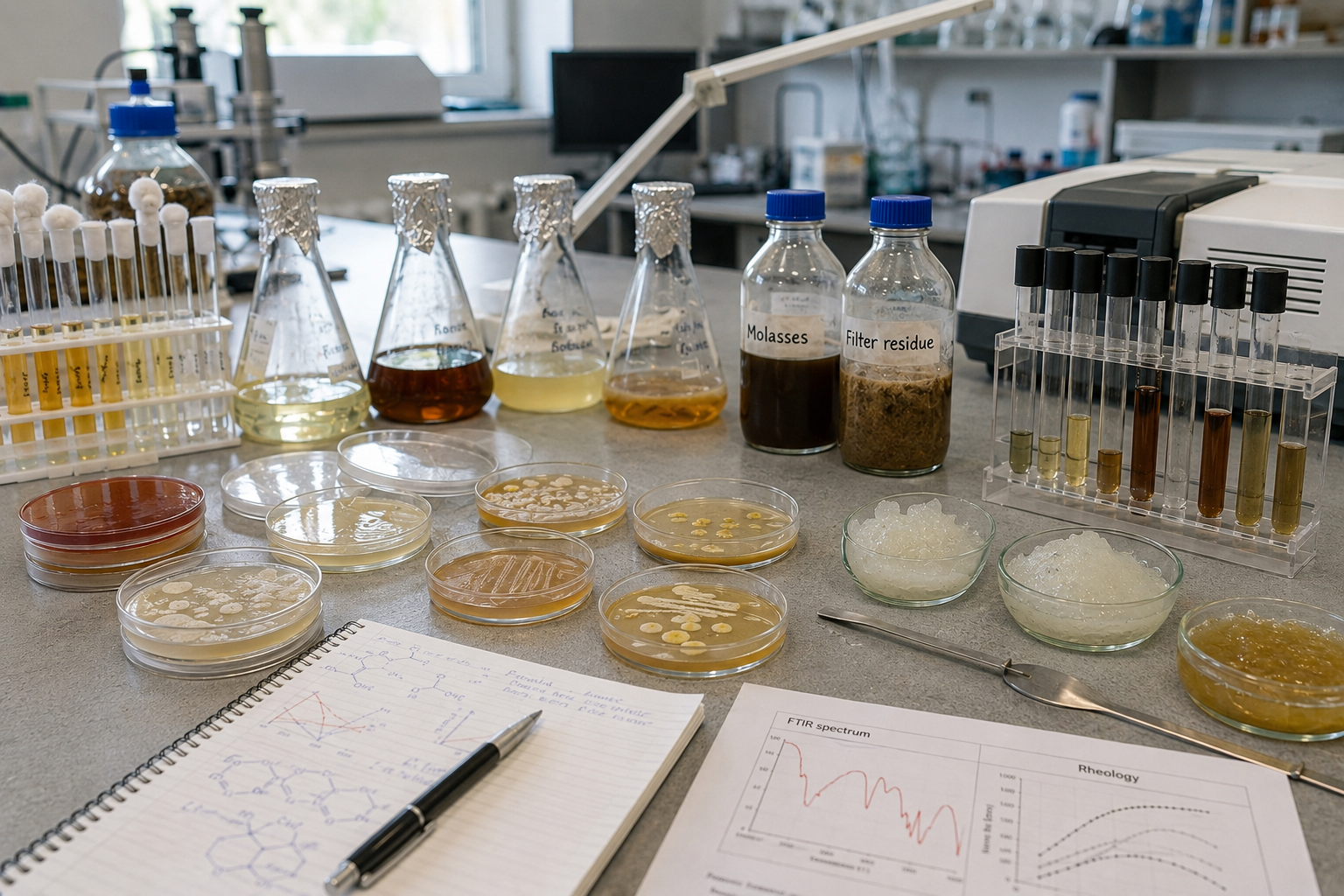
Scientists from Al-Farabi Kazakh National University are conducting research focused on the production of microbial exopolysaccharides (EPS) using new bacterial strains isolated from natural sources, the study of their properties, and the expansion of their practical applications. The project aims to improve approaches for producing environmentally friendly and biodegradable biopolymers, determine their physicochemical and biological characteristics, and assess their potential use in environmental technologies, the oil industry, agriculture, food production, and other fields.
Exopolysaccharides are high-molecular-weight natural polymers synthesized by microorganisms. They possess valuable properties, including high viscosity, emulsifying and gel-forming capabilities, thermal stability, and biocompatibility. These characteristics make microbial polysaccharides promising materials for applications in food production, medicine, pharmaceuticals, agriculture, cosmetics, and the oil industry. For example, xanthan-type polysaccharides are used to improve oil recovery because of their resistance to high temperatures and salts.
The project will investigate exopolysaccharides produced by new bacterial strains isolated from the rhizosphere of plants growing in the Trans-Ili Alatau mountains. The researchers will study strains belonging to the genera Mucilaginibacter, Sphingomonas, Agrobacterium, Xanthomonas, Rhizobium, as well as lactic acid bacteria of the genera Lactiplantibacillus and Lactococcus. These microorganisms have demonstrated high dynamic viscosity of their culture liquids and emulsifying activity toward petroleum hydrocarbons and vegetable oils.
The researchers will improve methods for extracting and purifying exopolysaccharides from culture liquids. The molecular weight, monosaccharide composition, structure, physicochemical and biological properties of the resulting polymers will be determined. Their emulsifying, flocculating, thermal stability, rheological, and gel-forming properties will also be studied to identify the most promising samples for further applications.
An important part of the research will focus on optimizing the cultivation conditions of EPS-producing microorganisms. The scientists will study the composition of the growth medium, cultivation time, temperature, pH, and type and concentration of carbon sources to identify conditions that maximize polysaccharide production. Instead of commercial sugars, waste products from the sugar industry, including molasses and filter cake, will be investigated as carbon substrates. This approach will support the rational reuse of industrial waste and improve the efficiency of microbial polymer production.
Another important direction of the project is the chemical modification of native exopolysaccharides. Acetylation and carboxymethylation will be used to investigate changes in polymer structure aimed at improving solubility, biological activity, and functional properties. The modified products will be characterized using infrared spectroscopy.
The project will also examine the rheological and gel-forming properties of native and modified exopolysaccharides. The researchers will assess their ability to form stable gels under neutral and alkaline conditions, increase viscosity, and form gels in the presence of divalent cations. The findings will help determine the potential of EPS for enhanced oil recovery, bioremediation of oil-contaminated soils, and regulation of drilling-fluid properties.
The scientific novelty of the project lies in the comprehensive investigation of new microbial exopolysaccharides obtained from natural sources that remain insufficiently studied in Kazakhstan. The project also involves producing native and modified polysaccharides using highly productive microbial strains and growth media based on sugar-industry waste, followed by an assessment of their functional properties. This approach creates a basis for developing new environmentally friendly biomaterials and expanding their potential applications.
The resulting exopolysaccharides may be used in environmental technologies for the remediation of oil-contaminated soils, in the oil industry to regulate drilling-fluid rheology and enhance oil recovery, as well as in agriculture, food production, and biotechnology. Their biodegradability, low toxicity, biocompatibility, and potential for chemical modification make exopolysaccharides promising materials for the development of new biomaterials.
The project is expected to identify promising EPS-producing strains and optimize their cultivation, extraction, and purification conditions. The effectiveness of native and modified EPS in gel formation, reservoir applications, and immobilization of hydrocarbon-degrading microorganisms will be experimentally assessed. Scientific publications and a patent application are also planned as project outputs.
The results of the project will contribute to building a scientific foundation for the study and practical application of microbial exopolysaccharides in Kazakhstan, advancing domestic biotechnology and supporting the development of new materials based on environmentally safe biopolymers. The research will also provide young scientists, master’s students, and doctoral students with opportunities to develop expertise in modern biochemical, microbiological, and physicochemical research methods.
Other news