- Main
- News
- “Qara Altyn” (“Black Gold”): A Film Bringing Together Spirit, Labour and National Identity
“Qara Altyn” (“Black Gold”): A Film Bringing Together Spirit, Labour and National Identity
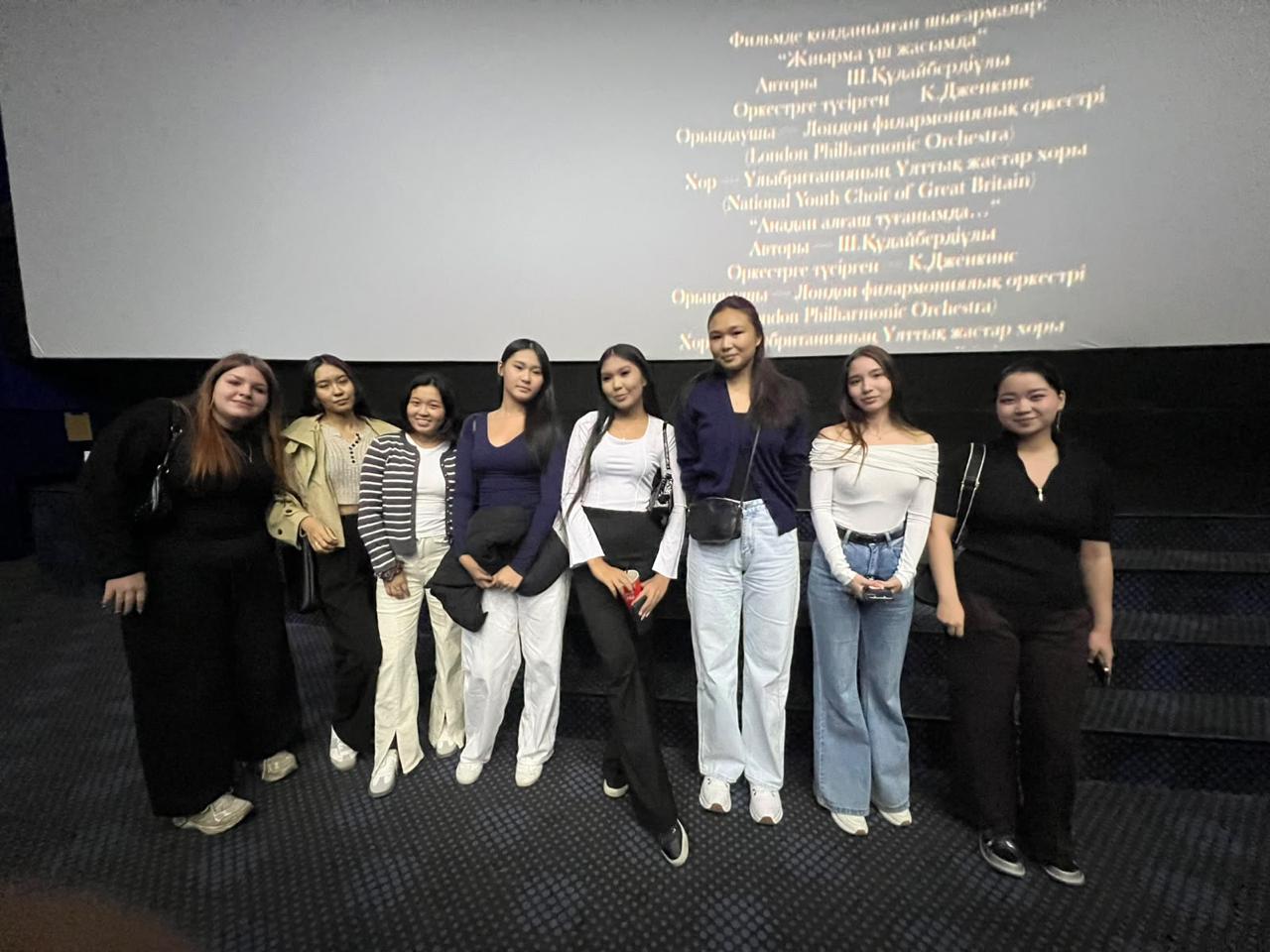
Zhanat Sarsenbay, PhD, Acting Associate Professor at the A. Baitursynuly Department of Kazakh Linguistics, Faculty of Philology, Al-Farabi Kazakh National University, attended a screening of the film Qara Altyn (Black Gold) together with the students of her academic advising group.
The cultural and educational event aimed to increase students’ interest in national cinema, promote the value of hard work, and foster respect for Kazakhstan’s history and spiritual heritage.
Although the title *Black Gold* primarily evokes the oil industry, the film’s thematic scope extends far beyond oil production. It explores human destiny, diligence and perseverance, risk-taking and entrepreneurship, national identity and historical memory, service to the country, and the continuity between generations.
Through the portrayal of the main character, Qasym Issagaliyev, the film highlights the importance of determination and decisiveness in pursuing one’s goals. The fact that he makes 32 attempts before achieving his objective on the 33rd serves as a symbolic detail that defines the film’s central message. This episode emphasises that every achievement requires hard work, self-belief and perseverance. The protagonist’s life journey encourages young people not to give up in the face of difficulties, to pursue their ambitions and to work for the benefit of their country.
From a genre perspective, the film combines dramatic tension with elements of detective fiction. The plot’s intrigue, the obstacles confronting the protagonist and his ability to find solutions in challenging situations reveal his intellectual capacity, composure and life experience. The dynamic development of events sustains the audience’s interest while encouraging deeper reflection on the values of work and responsibility.
Particular attention was also paid to the film’s linguistic and cultural dimensions. Its use of literary Kazakh, natural dialogue and preservation of national speech culture are among its notable strengths. Language functions not only as an artistic medium but also as a cultural code that conveys national worldviews. The film’s linguistic features further demonstrate the expressive and educational potential of the Kazakh language in public life.
Another distinctive feature of the film is its harmonious combination of national identity and modernity. The Soviet era, the period of independence, Kazakhstan’s emerging economic landscape, international settings and the development of the oil industry are woven into a coherent narrative. Through this approach, the film reveals the close relationship between an individual’s life journey and the history of the country.
One of the most significant artistic elements that deepens the film’s thematic meaning is its connection with the legacy of Shakarim. His literary works and philosophical reflections establish a spiritual link between the past and the present, older and younger generations, and national identity and the modern world. The revival of Shakarim’s song, preserved in an audio recording, and its performance on a major stage in London serve as a symbolic reminder of the enduring power of historical memory and cultural heritage across time and space.
The concept of *tek*, referring to ancestry and genealogical lineage, also carries particular significance. The narrative connecting the protagonist’s origins with Shakarim’s family links individual identity to historical memory. In this context, oil represents material wealth and economic development, while Shakarim’s legacy symbolises spiritual values and national consciousness. By bringing these two dimensions together, the film achieves greater thematic depth.
The film’s composition is also noteworthy. It is divided into eight parts, each with its own title. Beginning with a period of historical transition, the narrative follows the protagonist through decisive risks, the early stages of production, major investment projects and the development of the oil industry. These events are consistently interwoven with his personal journey.
The film’s national character is further enriched by its use of fairy-tale motifs and elements of traditional Kazakh cultural understanding. Episodes that echo the Kazakh folk tale *Maqta Qyz* highlight the relationship between traditional culture and contemporary industrial themes. Such artistic references reveal deeper layers of the national worldview.
For the students, watching the film together was more than a cultural outing; it was an educational experience that encouraged reflection on national values, historical continuity and the personal qualities of working people. Events of this kind broaden students’ perspectives, strengthen their interest in Kazakhstani cinema and foster respect for their country’s history and cultural heritage.
Overall, *Qara Altyn* is not merely a film about the history of oil production. It is a story about believing in one’s abilities, working persistently, taking calculated risks, overcoming challenges and contributing to the common good. The film is particularly meaningful in its portrayal of entrepreneurship and patriotism through concrete actions, as well as its emphasis on the civic commitment and responsibility of working people.
Promoting such films among young people is an important way to develop national consciousness and cultural appreciation, preserve historical memory and nurture responsible individuals who care about their country’s future.
Another valuable contribution to Kazakhstani cinema!
Qara Altyn is a distinctive film that brings together Kazakh traditions and modern industry, historical memory and individual destiny, material wealth and spiritual heritage. May Kazakhstani cinema continue to grow and produce meaningful films that strengthen national identity and inspire young people to work hard, persevere and serve their country!
Other news