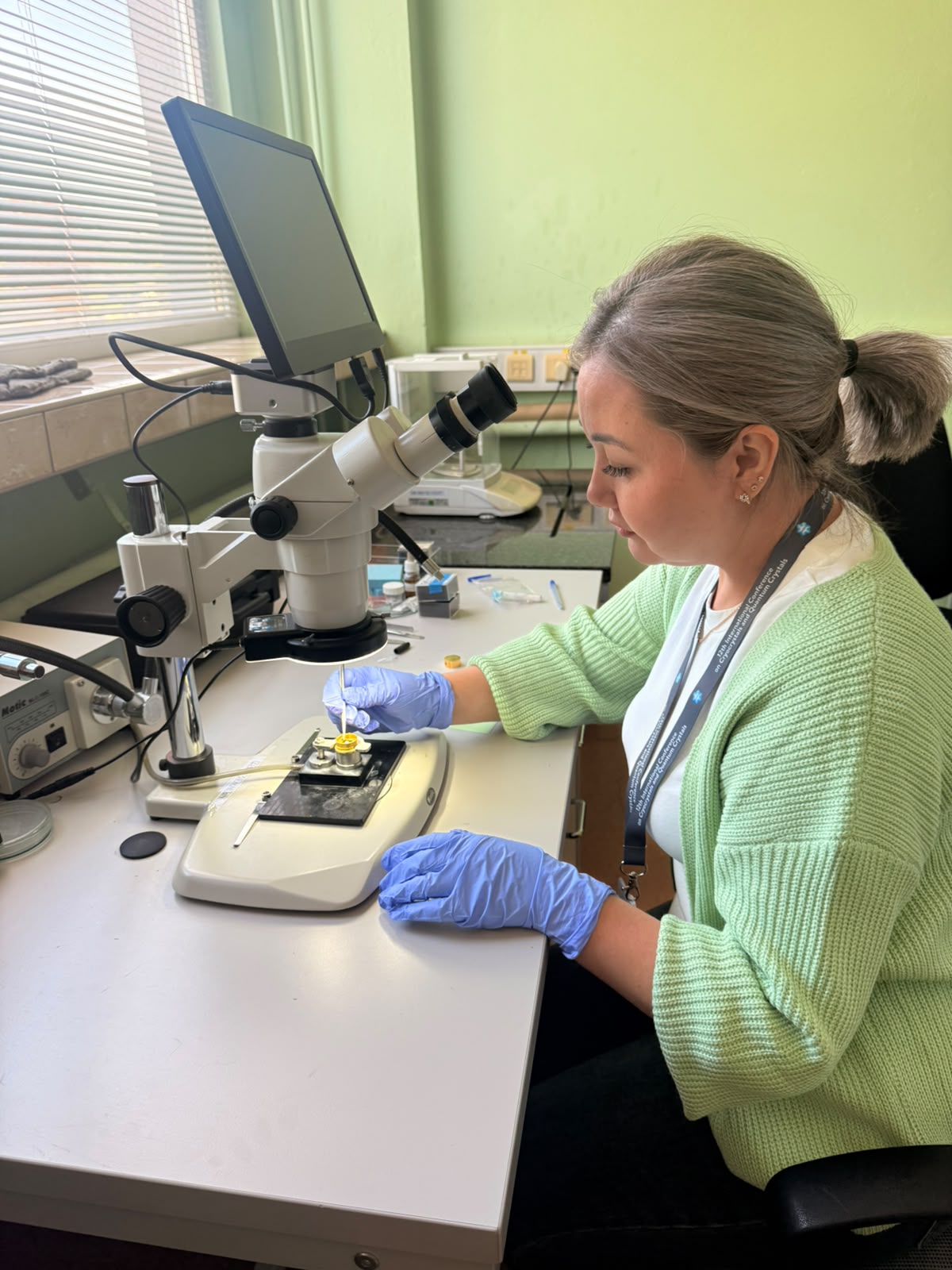
Nurgul Chigambayeva, a 3rd-year doctoral student of the educational program "8D0750-Standardization and Certification (by industry)" at the Faculty of Physics and Technology of Al-Farabi Kazakh National University, is undertaking a prestigious foreign scientific internship at the W. Trzebiatowski Institute of Low Temperature and Structure Research of the Polish Academy of Sciences (INTiBS PAN) in Wrocław, Poland. The research internship takes place from October 1 to October 31, 2026, under the expert supervision of a foreign scientific consultant, Doctor of Technical Sciences Daria Szewczyk.
This internship is specifically aimed at acquiring comprehensive practical experience in the field of low-temperature physics, mastering advanced experimental research, and utilizing modern high-precision measurement methods. INTiBS PAN is a leading international research institution specializing in low temperatures, superconductivity, solid-state physics, and investigating the fundamental properties of diverse advanced materials. Working within such a distinguished academic environment provides a unique opportunity to get acquainted with cutting-edge experimental setups, innovative methodologies, and international approaches to conducting scientific research.
The doctoral student's core practical work is focused in the laboratory of low temperatures and superconductivity, utilizing the advanced Physical Property Measurement System (PPMS). This sophisticated equipment is designed for the comprehensive and detailed study of the physical and thermophysical properties of materials across a broad range of cryogenic temperatures and strong magnetic fields. Working directly with the PPMS setup allows the doctoral student to thoroughly examine the operational principles of modern scientific hardware, the specific nuances of sample preparation, the organization of complex experimental processes, and modern data acquisition methods.
Throughout the internship, special attention is dedicated to exploring the analytical and diagnostic capabilities of the PPMS setup for investigating the thermal properties of materials at low temperatures. The doctoral student closely examines the precise protocols for conducting measurements, the conditions required for preparing and mounting samples, the fundamental principles of recording experimental parameters, and modern approaches to analyzing obtained results. This practical activity is aimed at mastering experimental techniques and evaluating the critical factors affecting measurement accuracy and reproducibility.
An essential and vital component of the internship is the in-depth study of the methodological aspects governing low-temperature experiments. Special emphasis is placed on ensuring reliable thermal contact between the sample and measuring elements, selecting optimal testing conditions, assessing potential sources of error, and guaranteeing the absolute reliability of experimental data. The acquired knowledge significantly deepens the understanding of the principles underlying thermophysical studies and the specifics of operating high-precision scientific equipment.
Familiarizing oneself with modern measurement systems fosters a clearer understanding of the interdisciplinary relationship between measurements, metrological support, automated data processing, and result validation. In addition to practical laboratory work, the internship offers exceptional opportunities to integrate into the international scientific community, explore foreign institutional practices, and engage in professional communication with leading international experts. Regular interaction with the scientific advisor and laboratory staff broadens professional horizons and facilitates the adoption of innovative research strategies.
In addition, the ongoing research aligns naturally with global sustainable development priorities: it promotes quality education through knowledge acquisition (SDG 4), engages with cutting-edge infrastructure and technological innovation (SDG 9), and fosters international cooperation and professional networking (SDG 17).
In conclusion, the international research internship at INTiBS PAN significantly enhances the doctoral student's professional qualifications, refines practical skills with high-tech equipment, and deepens expertise in low-temperature experimental research. The acquired experience will serve as a robust foundation for completing the dissertation, preparing high-impact scientific publications, and fostering further research excellence.