Al-Farabi and his contribution to the history of humanity
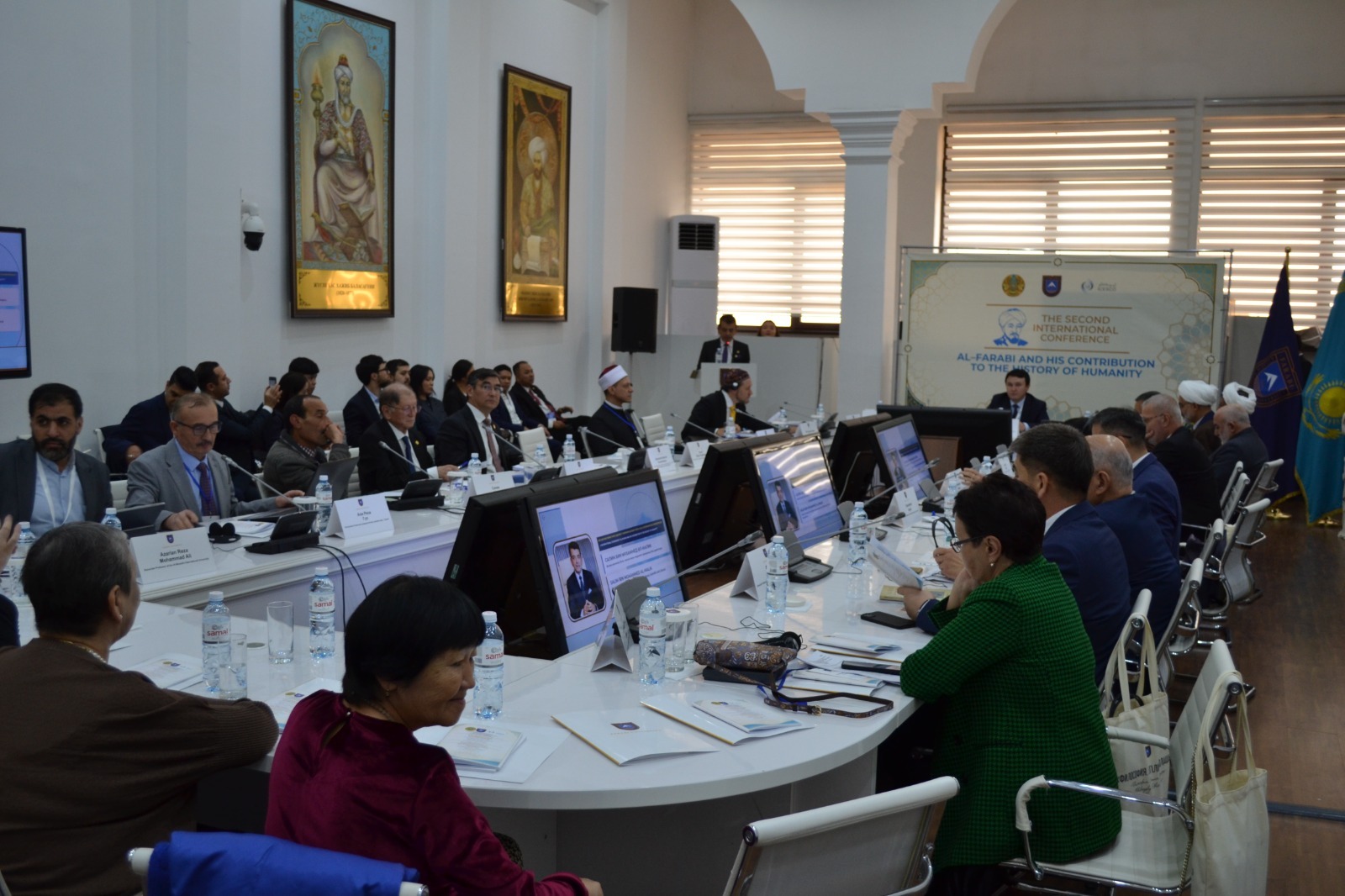
On November 6, 2026, the II International Conference entitled “Al-Farabi and His Contribution to the History of Humanity” was held at Al-Farabi Kazakh National University in cooperation with the Islamic World Educational, Scientific and Cultural Organization (ICESCO).
The international event was organized as part of the “Al-Farabi – 2026” Symposium and focused on exploring the philosophical and scientific legacy of Abu Nasr al-Farabi, identifying his place in the development of world civilization, and discussing the relevance of his ideas in the contemporary world.
The plenary session was opened by Bekzhan Meirbayev, Dean of the Faculty of Philosophy and Political Science at Al-Farabi KazNU, who spoke about the history of the establishment of international scientific cooperation. According to him, the initiative dates back to October 11–12, 2023, when the I International Conference entitled “Al-Farabi’s Contribution to the History of Humanity” was held at the ICESCO headquarters in Rabat, the capital of Morocco. During that meeting, a Memorandum of Cooperation was signed between KazNU and ICESCO, establishing new areas for the joint study and promotion of al-Farabi’s legacy. The current conference represents a natural continuation of this international partnership.
At the opening ceremony, Margulan Ibragimov, Member of the Management Board and Vice-Rector for Research and Innovation at Al-Farabi KazNU, delivered a welcoming address, emphasizing the outstanding place of the great thinker in the history of world science and philosophy.
“Abu Nasr al-Farabi is a great thinker who holds a distinguished place not only in the history of Turkic-Islamic civilization but also in the history of the scientific and philosophical thought of all humanity,” the Vice-Rector noted.
He also highlighted the significance of al-Farabi’s legacy in understanding contemporary scientific and social challenges, emphasizing the need to examine issues such as artificial intelligence ethics, sustainable development, social justice, the role of education and science in society, and good governance in the context of the great thinker's ideas. In addition, the Vice-Rector spoke about the ongoing efforts to advance al-Farabi studies at the university.
Speaking at the opening ceremony, Salim M. Al-Malik, Director-General of the Islamic World Educational, Scientific and Cultural Organization (ICESCO), emphasized al-Farabi’s exceptional place in the history of world philosophy and civilization. He noted that the legacy of the great thinker is a shared intellectual heritage not only of the Islamic world but of all humanity.
“Although al-Farabi belongs to the history of the Islamic world, his legacy is the common heritage of all humanity. Kazakhstan holds a special place in this history and has an important mission to introduce the world to the legacy of the great thinker,” the ICESCO Director-General stated.
The plenary session brought together prominent scholars and representatives of international organizations from Kazakhstan, Morocco, Malaysia, Russia, Egypt, Iran, Tunisia, Türkiye, and Japan. Among the participants were Osman bin Bakar, Rector of the International Islamic University Malaysia and Professor Emeritus; Damir Mukhetdinov, First Deputy Chairman of the Spiritual Administration of Muslims of the Russian Federation; Muhammad Abdu ar-Radi Wardani, Rector of the Egyptian University of Islamic Culture “Nur-Mubarak”; Kuanysh Yergaliyev, ICESCO Director for Science and Innovation; Hamid Mohammad Reza Parsania, Professor at the University of Tehran; Salem Ayadi, Associate Professor at the University of Sfax (Tunisia); Yashar Aydinli, Professor at Uludag University (Türkiye); and Tatsuya Yamazaki, Research Fellow at the Institute of Oriental Philosophy (Japan). Kazakhstan was represented by prominent scholars and specialists in al-Farabi studies and philosophy, including Zhakypbek Altayev, Dosai Kenzhetay, Samal Toleubayeva, Ainur Kurmanaliyeva, Ykhtiyar Paltore, Asyl Tuleubekov, and other researchers.
The conference also featured presentations of new academic publications and monographs in the field of al-Farabi studies. These included “The World of Al-Farabi: A Collection of Studies” by Zh. Altayev and K. Altynbek; the monograph “The Problem of Human Being in Al-Farabi’s Philosophy of Religion” by N. Baitenova, B. Meirbayev, and S. Baizhuma; the collective monograph “Al-Farabi’s Legacy: The Philosophy of Language and the Language of Philosophy” by scholars of the Department of Religious Studies and Cultural Studies; “Al-Farabi’s Dictionary of Philosophical Terms: Arabic-Kazakh-Russian”; and the Kazakh translation of the book “Al-Farabi: His Life, Works and Significance” by Malaysian scholar Osman bin Bakar, translated by Y. Paltore.
These publications aim to deepen the study of the great thinker's philosophical legacy, expand the body of academic research, and promote the development of al-Farabi studies at the international level.
The conference continued with four academic sessions. The discussions focused on al-Farabi’s legacy and global challenges, the philosophy of the future, fostering responsible citizenship, and issues related to the development of Kazakhstan’s school of al-Farabi studies. Participants exchanged academic views and presented their proposals on relevant research areas.
Following the conference, participants emphasized the need to further promote international research into al-Farabi’s rich scientific and philosophical heritage, strengthen academic ties between domestic and international scholars, and develop joint research projects and scholarly publications.
The international conference made a significant contribution to promoting the legacy of the great thinker within the global academic community, advancing al-Farabi studies, and strengthening intercivilizational scientific and cultural dialogue.
Other news