- Main
- News
- AN OPEN CURATORIAL SESSION ON “THE TENGE – THE FINANCIAL FOUNDATION OF INDEPENDENT KAZAKHSTAN” WAS HELD AT KAZNU
AN OPEN CURATORIAL SESSION ON “THE TENGE – THE FINANCIAL FOUNDATION OF INDEPENDENT KAZAKHSTAN” WAS HELD AT KAZNU
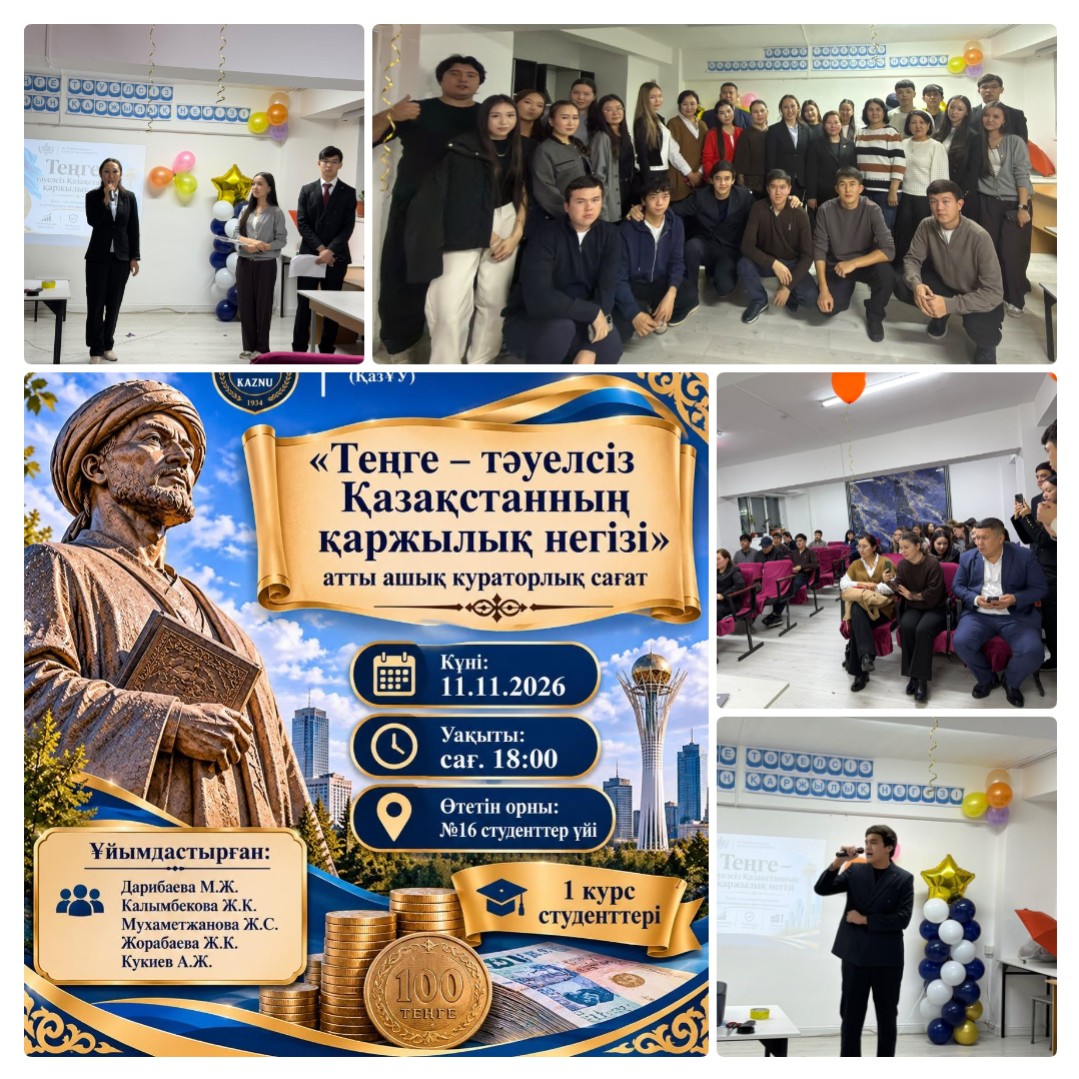
On November 11, 2026, an open curatorial session entitled “The Tenge – the Financial Foundation of Independent Kazakhstan” was held at Student Residence Hall No. 16 of Al-Farabi Kazakh National University to commemorate National Currency Day.
The event was organized within the framework of the United Nations Sustainable Development Goals (SDGs), particularly SDG 4 – “Quality Education,” SDG 8 – “Decent Work and Economic Growth,” and SDG 16 – “Peace, Justice and Strong Institutions.”
The primary objective of the event was to familiarize students with the history of the establishment of Kazakhstan's national currency, the tenge, its economic significance, and its role in strengthening the country's independence. The session also aimed to enhance financial literacy among young people, develop their economic thinking skills, and foster respect for national values.
During the curatorial session, participants received comprehensive information about the history of the tenge, the historical circumstances surrounding its introduction, and the economic necessity of establishing a national currency. Particular emphasis was placed on the introduction of the tenge into circulation on November 15, 1993, which marked one of the most significant milestones in the development of Kazakhstan's economic independence.
Furthermore, it was explained that the introduction of the national currency created opportunities for implementing an independent monetary policy, developing the national financial system, and ensuring the country's economic stability.
The meeting addressed the role of the national currency in Kazakhstan's economy, including inflation, monetary circulation, exchange rates, and financial stability. Students also gained valuable insights into personal budget planning, income and expenditure management, savings accumulation, financial risk assessment, and responsible financial decision-making.
Within the framework of SDG 4 – “Quality Education,” particular attention was paid to improving students' economic knowledge, enhancing their financial literacy, and developing practical skills for applying financial knowledge in everyday life.
In the context of SDG 8 – “Decent Work and Economic Growth,” the discussion focused on financial responsibility, savings culture, and the contribution of personal financial stability to the economic development of society.
In accordance with SDG 16 – “Peace, Justice and Strong Institutions,” the importance of the national currency in ensuring the country's economic sovereignty and the role of stable financial institutions in sustainable development were emphasized.
The educational component of the event was complemented by a cultural and artistic program. Students demonstrated their creative talents by performing traditional songs and beautiful Kazakh kyuis on the dombra, a traditional Kazakh musical instrument.
The musical performances created a special cultural and spiritual atmosphere, bringing positive emotions to the participants. These performances also contributed to promoting national culture, traditions, and spiritual values, while fostering appreciation for Kazakhstan's rich artistic heritage among the younger generation.
First-year students actively participated in the curatorial session, expressed their opinions, and engaged in discussions. Particular attention was drawn to the fact that the tenge is not merely a means of payment but also an important symbol of Kazakhstan's state sovereignty and economic independence.
Such educational, cultural, and awareness-raising activities contribute to developing the financial literacy and financial culture of future professionals, fostering respect for national values, strengthening civic responsibility, and promoting a deeper understanding of sustainable development principles.
These initiatives also demonstrate the university's commitment to combining quality education with cultural enrichment and the development of financially responsible citizens capable of contributing to the sustainable economic growth of Kazakhstan.
Organizers: M.Zh. Daribayeva, Zh.K. Kalymbekova, Zh.S. Mukhametzhanova, Zh.K. Zhorabayeva, and A.Zh. Kukiyev, lecturers of the Department of Finance and Accounting, Higher School of Economics and Business, Al-Farabi Kazakh National University.
#KazNU #NationalCurrency #TengeDay #FinancialLiteracy #SDG4 #SDG8 #SDG16 #SustainableDevelopment #FinanceAndAccounting
Other news