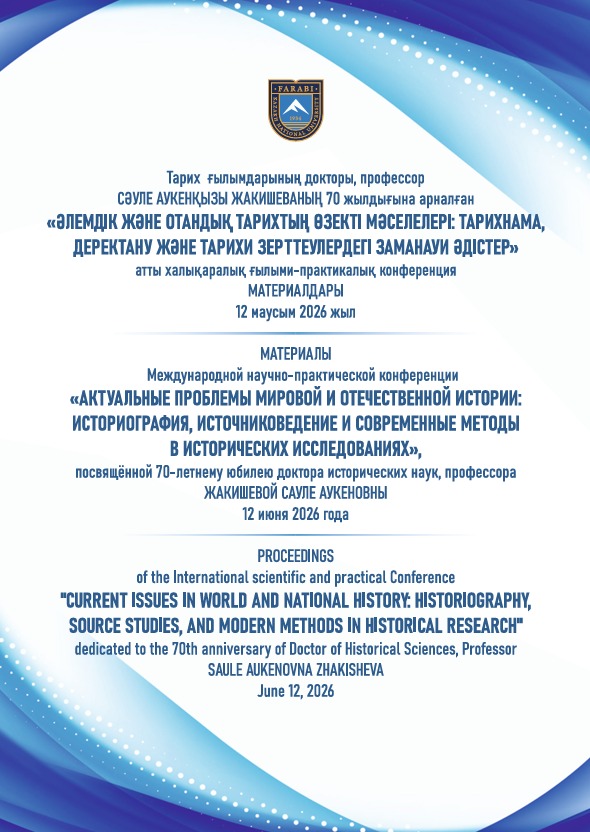
On June 12, 2026, the Faculty of History of Al-Farabi Kazakh National University hosted the International Scientific and Practical Conference "Current Problems of World and National History: Historiography, Source Studies, and Modern Methods in Historical Research," dedicated to the 70th anniversary of Doctor of Historical Sciences, Professor Saule Aukenovna Zhakisheva—a prominent Kazakhstani historian and the founder of historical information science in the Republic. The thematic concept of the conference was directly tied to the primary areas of the honoree's academic work, while encompassing a broad range of pressing issues in contemporary historical scholarship: world and national history, historiography and source studies, the history of political repressions and historical memory, quantitative history and historical information science, Digital History and Digital Humanities, historical databases, geoinformation and network methods, digital hermeneutics, and artificial intelligence technologies.
The conference was distinguished by a wide geographical reach and a prestigious lineup of participants. In total, 67 authors of scientific reports from Kazakhstan, France, Russia, Uzbekistan, and Armenia were registered for the plenary and panel sessions. The Kazakhstani representation included Almaty, Astana, Karaganda, Zhezkazgan, Aktobe, Kokshetau, Pavlodar, and Shymkent; the Russian geography encompassed Moscow, St. Petersburg, Yekaterinburg, Barnaul, Krasnoyarsk, Perm, Kursk, Abakan, and Kyzyl. The international presence was further expanded by scholars from Paris, Tashkent, and Yerevan. The conference brought together representatives of universities, academic institutes, research centers, and other educational and scientific institutions. The agenda included a plenary session, five thematic sections, and a concluding scientific discussion.
The conference was organized by the Faculty of History of Al-Farabi KazNU. The organizing committee was headed by the Chairman of the Board – Rector of Al-Farabi KazNU, Zh. K. Tuimebayev, who awarded the honoree the Silver Medal "For Merit to Al-Farabi KazNU". The plenary session was moderated by the renowned Kazakhstani medievalist, Doctor of Historical Sciences, Professor K. T. Zhumagulov.
The formal ceremony opened with congratulations addressed to the jubilee celebrant. Congratulatory addresses were delivered on behalf of the Rector of Al-Farabi KazNU Zh. K. Tuimebayev; Rector of the Ye. A. Buketov Karaganda National Research University N. O. Dulatbekov; Director of the Ch. Ch. Valikhanov Institute of History and Ethnology, Academician of the National Academy of Sciences of the Republic of Kazakhstan (NAS RK) Z. E. Kabuldinov; Head of the Project Office of the State Commission for the Complete Rehabilitation of Victims of Political Repressions, Candidate of Legal Sciences S. A. Kasymov; Director of the Ural Institute of Humanities of UrFU named after the First President of Russia B. N. Yeltsin, Academician of the Russian Academy of Education (RAE) E. E. Symanyuk; Chairman of the Pugwash Committee of Kazakhstan V. Shkolnik; President of the Interregional Association of Researchers in Historical Information Science, Professor of Altai State University V. N. Vladimirov; Academician of the NAS RK, Head of the Department of History of Kazakhstan at KazNU B. B. Karibaev; Chairman of the "Parasat" Trade Union of KazNU T. K. Mekebaev; Dean of the Faculty of History, Doctor of Historical Sciences D. S. Baigunakov, and others. Following the congratulations and awards, the academic program of the conference commenced.
The problems of historical information science and quantitative history occupied a central place at the plenary session. Corresponding Member of the Russian Academy of Sciences (RAS), Head of the Department of Historical Information Science at the Faculty of History of Lomonosov Moscow State University (MSU), Doctor of Historical Sciences, Professor L. I. Borodkin delivered a report titled "Data Analytics on the Dynamics of Wage Inequality in Soviet Industry During the First Five-Year Plans". The study addressed the problem of material incentives for industrial labor during Soviet industrialization. Drawing upon statistical sources, the speaker illustrated the transition from the relatively egalitarian approach of the 1920s to intensified wage differentiation during the first five-year plans. To measure inequality, the decile ratio, the Gini coefficient, and other quantitative indicators were employed. Of particular interest was the conclusion that during the second five-year plan, the actual level of wage differentiation in metallurgy proved to be higher than the level prescribed by the revised tariff scale. The presentation vividly demonstrated the research potential of historical data analytics, where quantitative methods not only illustrate well-known processes, but also clarify their scale and dynamics.
The paper by Doctor of Historical Sciences, Professor, and Honored Scientist of the Russian Federation T. I. Slavko, titled "Mathematical Methods for Studying Mass Historical Sources in Russia in the 1960s–1980s," was devoted to the historiography and development of the quantitative approach in historical science.
The plenary session also highlighted pressing issues surrounding the application of artificial intelligence and machine learning in the research of Moscow scholars. Doctor of Historical Sciences Yu. Yu. Yumasheva examined the potential of new technologies and associated methodological issues of source studies in her report "Opportunities and Challenges of Applying Artificial Intelligence Technologies in Source Studies," while Candidate of Historical Sciences, Associate Professor of the Department of Historical Information Science at MSU A. Yu. Volodin delivered a paper titled "Digital Hermeneutics in the Toolkit of a Historian Struck by the Achievements of Machine Learning". His focus was on digital hermeneutics as a method for transforming a historian's source observations into formalized data. The presentation explored source-oriented and problem-oriented approaches to the datafication of historical observations, the problem of abstraction in the acquisition of historical knowledge, and the danger of presuming digital tools to be inherently objective. A key proposition of the talk was the necessity of critical reflection by researchers on algorithms and interfaces, as well as the cultivation of multimodal literacy in modern historians.
A substantial block of plenary and sectional presentations was dedicated to the history of Kazakhstan in the Soviet period, political repressions, the GULAG, migration, and historical memory. Doctor of Historical Sciences, Professor of Ye. A. Buketov Karaganda National Research University Z. G. Saktaganova presented her research "Women and Children Contingents in the Kazakhstan Camps of the GULAG: On Medical and Sanitary Care in the 1930s – Early 1940s (Based on Karlag Materials)". K. N. Baltabayeva and T. K. Allaniyazov examined relations between refugees and the host society based on documents of party and Soviet organs from the 1920s–1940s. The theme of political repressions continued across the panel discussions, testifying to the enduring academic relevance of examining the mechanisms of Soviet repressive policy, its social repercussions, and its reflections in historical memory.
A prominent place in the first section was occupied by the paper "Current Problems in the Study of the History of the Kazakh ASSR" by Doctor of Historical Sciences, Professor, Chief Researcher of the Institute of Russian History of the RAS D. A. Amanzholova. The focus of one of the leading experts on national policy and state-building of the Soviet era on the Kazakh ASSR made it possible to integrate Kazakhstani material into a wider research framework regarding the Soviet model of statehood, nationalities policy, and the institutional development of autonomous republics.
The international dimension of research on the Soviet repressive apparatus was most prominently featured in the presentation by French historian Guillaume Minea-Pic—PhD in History and Civilization, researcher at the Centre for Russian, Caucasian, East European, and Central Asian Studies (CERCEC, EHESS/CNRS, Paris, France). His report, "Modern Historiography of the GULAG: Debates, Trends, Renewal, and Continuity over the Past Decade," inaugurated the first panel. The French researcher's presentation was vital not only in terms of specific GULAG historiography, but also as a venue for comparing domestic, Russian, and Western European historiographical approaches to studying the Soviet repressive system.
A dedicated direction of the conference was devoted to modern information technologies in historical research. In this section, Candidate of Historical Sciences, Associate Professor of the Department of Historical Information Science at MSU S. A. Salomatina presented the report "Modern Methods of Network Analysis in Historical Science (A Review of 'The Journal of Historical Network Research')". Based on ten specific historical studies spanning various eras and geographies, the possibilities of historical network analysis were demonstrated. The presentation showed that the application of network methods does not necessarily require fundamentally new sources: researchers can operate with traditional bodies of historical material, while structured data reveals networks of interactions between people, institutions, and geographic locations. Particularly significant was the conclusion that network analysis, as part of a broader research agenda, can reorganize accumulated material and lead to findings that revise established historiographical notions.
The participation of scholars representing academic schools from other Central Asian states was also notable. Z. R. Ishankhodzhaeva, Professor at the National University of Uzbekistan named after Mirzo Ulugbek (Tashkent), addressed the use of artificial intelligence and digital humanities in studying the history of World War II and the memorialization of historical memory. This direction is particularly emblematic of current historical research, as digital methods are deployed not only for source processing, but also for analyzing mechanisms behind the formation, preservation, and representation of collective memory. Armenia was represented by Doctor of Historical Sciences, Professor E. Sh. Khurshudyan, who presented the paper "Chemolgan / Shemolgan: A Sogdian Toponym in Turkic Adaptation". In the official program, he was listed as Ambassador Extraordinary and Plenipotentiary of Armenia and General Director of "Hi-Telco Kazakhstan," representing Yerevan – Almaty. His study expanded the scope of the conference through a historical, linguistic, and source-critical analysis of cultural interactions in Central Asia.
Overall, the conference proceedings were structured into five thematic sections covering pressing problems of world and national history, historiography and the reassessment of historical knowledge, source studies and modern methods of source analysis, information technologies in historical research, as well as socio-economic and political processes in ancient, medieval, modern, and contemporary history. The very structure of the forum demonstrated the organizers' commitment not to segregate traditional and digital branches of historical scholarship, but to unite them within a single research domain. The first section was dedicated to current problems of world and national history, the second to historiography, and the third to source studies and modern methods of source analysis.
The conference also showcased an inspiring dialogue across generations of researchers. Alongside academicians, doctors of sciences, professors, and leaders of established academic schools, doctoral candidates and postgraduate students actively participated in the panel sessions.
One of the most consequential outcomes of the conference was highlighting an overarching trend in modern historical science: cutting-edge digital technologies do not render traditional source criticism obsolete; rather, they impose higher standards upon it. Historical databases, GIS, network analysis, digital hermeneutics, machine learning, and artificial intelligence require preliminary source criticism, the formalization of historical information, comprehensive provenance documentation, evaluations of source completeness and representativeness, and indispensable contextual interpretation of findings. In this regard, bringing together historiography, source studies, and modern research methods within the conference's title accurately captured its core scientific paradigm.
The international and interregional composition of the participants facilitated a comparison of diverse scholarly traditions and methodologies. The participation of scholars from Kazakhstan, Russia, France, Uzbekistan, and Armenia, along with the representation of major metropolitan and regional research centers, university academia, and national academies, fostered professional dialogue across a wide array of topics—from the history of the Kazakh ASSR, political repressions, and the GULAG to historical networks, digital hermeneutics, and AI. An equally vital result was the consolidation of professional ties between the Kazakhstani school of historical information science and prominent Russian and international research institutions.
Following the conference, a collection of academic papers was published, consolidating research across all primary panels of the forum. The thematic architecture of the publication reflects the character of contemporary historical scholarship, in which empirical historical research, historiography, and source studies increasingly interface with interdisciplinary and digital analytical tools.
The conference in honor of Professor S. A. Zhakisheva's 70th birthday was both a scholarly and commemorative milestone. Reflecting on the honoree's academic career naturally served not only as a summation of decades of research and pedagogical activity, but also as a platform for discussing the future trajectory of historical science. Notably, colleagues from the Department of Historical Information Science at MSU's Faculty of History, in their post-conference report published on the Moscow State University website (https://www.hist.msu.ru/about/gen_news/114629/ https://www.hist.msu.ru/about/gen_news/114629/), specifically underscored S. A. Zhakisheva's pioneering role as the founder of historical information science in Kazakhstan and wished continued growth and prosperity to the Kazakhstani school.
Thus, the International Scientific and Practical Conference "Current Problems of World and National History: Historiography, Source Studies, and Modern Methods in Historical Research" ventured far beyond a commemorative celebration. It served as a venue for substantive professional dialogue among diverse scientific schools, countries, and generations of scholars, demonstrated the strong potential of international collaboration, and outlined promising avenues for the development of historical science. The forum's academic agenda convincingly demonstrated that the future of historical research lies in the integration of rigorous source criticism, interdisciplinary methodology, and advanced digital technologies, elevating the study of historical processes to a qualitatively new level.